By Richard Templar
I try to arrive with just minutes to spare for trains, because I know I will get suckered into train station shop marketing. Back in January, I was headed to Durham. As any northerner will tell you, direct trains from London to the North are not the cheapest of train fares, so I really didn’t want to risk missing this one. I arrived 40 minutes early at Kings Cross. Not having much else to do but stroll around I eventually found WHSmith tempted me in with their buy-one-get-one-half-price deal, and I walked out with this book in my hand. . .
. . . It took me 6 months though to actually get round to reading it!
This book is not exactly what I would call a “good read”. You don’t have to read it cover to cover, or in any particular order. It’s basically 100 two-page long descriptions of certain rules to think more rationally, become a better decision maker and understand human natural behaviour a tiny bit better. It’s actually a bit much to read in one go, I couldn’t remember rules from twenty pages ago. And it wasn’t particularly enjoyable. I didn’t feel like reading it late at night or if I was relaxing on the beach (yes, I went to a UK beach in June. And yes, the water was bloody cold!) . I actually was reading another book alongside this one, to fill in all the gaps which a good book should.
So what was good about it? It’s the kind of book which you dip into. If you read a couple of chapters a week and made a conscious effort to implement them into your life and your decision-making, assuming you have good self-discipline, you would be better off over time. The author makes many valid points, which almost everyone would have heard of elsewhere, such as, the threat of misusing statistics, or one should always see from where an opinion is spoken from. The book basically condenses a lot of assumed knowledge into bite-size chapters with a title, anecdote, some facts to support and a take-home message. This makes a good book to have on the shelf and to refer to every so often to initiate new habits.
There are 100 “rules” to implement. I think it is assumed, everyone naturally does some rules without thinking; knows there are some things they should do but sometimes emotions take over; and then there is a list of rules which one probably never really considered all that important. Aside from it being just good habits to follow, I wouldn’t delve more into understanding each chapter.
Richard Templar also writes in such a way which you can’t argue with him. Nothing he says is an “absolute” rule, and constantly writes throughout that he expects his readers to fact check, evaluate, come to their own conclusions, and not to take his word as the ONLY way of doing things. How can you argue against that? I guess, at least the author follows his own rules!
Due to the nature of the book, everyone will read it and take away different points. There is no beginning, middle, conclusion. There’s no right or wrong. It’s the dictionary equivalent of how to think. Therefore, this review is only going to encompass what I learned from the book. Feel free to comment your favourites parts too.
My favourite chapters and quotes
“When someone else says what you were already thinking, it makes you feel validated, makes you feel you must be right, reinforces your view, makes you feel you must belong. Cultivate friends based on who they are, not what they believe.” ——– I always knew this I think. But seeing it on paper validated my opinion I suppose (ironic right?). Life would be dull if everyone thought the same as you.
“Anyone’s response who makes you feel worse, is not good support.” ——- So true! Get rid of negative people is obvious. But this is more subtle. They might not be outwardly negative, but if they don’t make you feel good, they’re not helping you!
“Rule 24: Laugh at yourself” —— This is one I am actively trying to adopt. I should learn to be more happy-go-lucky. Find the fun. Be jolly.
“People who believe they control their own lives, tend to be happier. Feeling like a victim takes power away from you, leaving you feeling helpless.” —– Another reason not to believe in a predetermined fate. We decide our destiny!
“Self-esteem is about how much worth you believe you have as a person. It’s not the same as confidence – which is more to do with the skills and abilities you feel you have.” —- I get these confused a lot. People would describe me as confident, but I never felt it. I always think I’m not good enough. Now I realise I just lack self-esteem. But I’m confident in the abilities have.
“Rule 31: Keep the bar steady” —– This is about setting goals, and when we get near to our goal we increase it. So we never actually ever achieve our goals as we always raise it out of our reach to “push ourselves”. What one should actually do is set a goal, hit it, and then set a new one. Then, achieving goals becomes a habit.
“Hanlon’s razor: Never attribute to malice what is adequately explained by stupidity.” —– This is one of my favourite “razor’s”, alongside Occam. People (vast majority) are not nasty, they’re just ignorant.
“Busy isn’t necessarily productive.” —– Yes!
“Rule 34: Learn to love a list. Something quick. Something you enjoy. Something you’ve already done.” ——- If you haven’t been introduced to Workflowy, I highly recommend! It’s a super simple list making tool, via app or web. You can share it, sync it across devices. And my favourite part is crossing off all the tasks I’ve completed. Makes me feel uber productive!
“It’s amazing how often you meet deadlines simply because they’re there. Learn to use them to your advantage, but not let it bring added stress.” —– I have definitely noticed that I seem to never miss a deadline if there is one. And if there isn’t, the task never gets done. Now I give myself deadlines, such as having to finish a blog post every other Tuesday! Still trying to psychologically trick myself that self-made deadlines are just as important as outside-imposed ones.
“Genius is 1% inspiration and 99% perspiration ~Thomas Edison” —– Nice to read it frequently as a reminder.
“If you want to have good ideas, you must have many ideas ~Linus Pauling” —– Obviously have to include a biochemist quote in here somewhere. Even if it has nothing to do with biochemistry….
“Mistakes do not make you a failure. They are just identifying a barrier to success and all you need to do is overcome or circumvent each barrier and you’ll succeed.” —— I need to remind myself of this. I hate being wrong and failing at things! But sometimes it goes so far that I don’t even try out of fear of failing. It’s just a barrier to overcome not a blockade!
“Rule 54: Don’t settle for your first answer” —– Maybe your first answer has previously been the best answer. But there’s no way it will ALWAYS be the best answer.
“The biggest problem can be knowing where to start” —– When I was age 7, we used to get tasks in school like to write a story. I could never start at the beginning. My imagination just didn’t work that way. I used to start in the middle of the story, write that, write the end, then go back and write the beginning. Moral of this story: Just start somewhere, and gain momentum.
“Rule 60: Get help. Being able to ask for help is a strength. All of us are happy to ask for help in areas we have no ego.” —— My gosh, this is a major downfall of mine! I see asking for help as a failure. Therefore, never do, and give myself so much unnecessary work and stress.
“I’ve got a stupid idea, but I’m going to say it anyway because someone might turn it into a good idea.” —— Now that’s a good idea!
“Rule 85: Be honest about procrastinating. Look your decision in the face and admit why you aren’t getting on with it.” —– I procrastinate a lot!! Fear of failure most of the time…. Wow, that keeps cropping up for me. Must get over this fear! Must get over this fear!
“Assumption is just an excuse for lazy thinking” —— Never thought of it like that before. Woah!
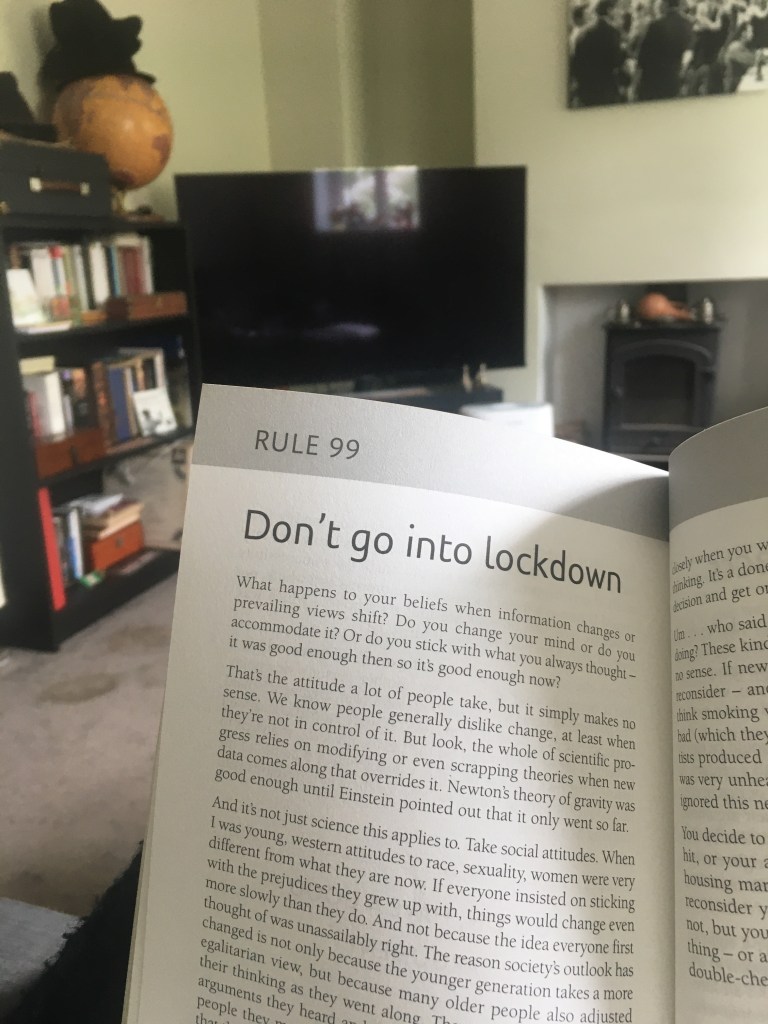
“Rule 100: opinions aren’t facts. This is the reason why it’s said you should never discuss politics or religion because it always leads to arguments. People change their minds on these points through rational argument, because they’re not rational standpoints. They’re valid beliefs, but they weren’t arrived at through logical reasoning and they’re not going to give way to it. Nevertheless people like to debate them as if they were rational and can get extremely heated when they have to defend their non-rational position against a set of facts and statistics that may offer a serious challenge.” ——- Self-explanatory
Conclusion
I would not gift this book to anyone, nor probably recommend it. It’s pretty basic stuff. Nice layout though and it’s written coherently. I would say it’s a book that is good to have on the shelf. If there’s a buy-one-get-one-half-price sale, then pick it up. But don’t expect to be amazed by anything written inside. It’s not about “thinking”, more about how to act and react in a productive manner.
 One Too Many Books